


May 13, 2015
5V

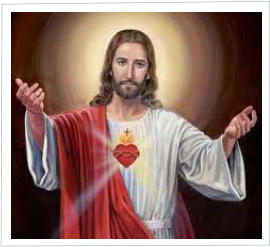
“Come, My Heart is an abyss of Mercy, Love and Tenderness!” “My Sacred Heart is your Heaven!”
“Look at My Heart .... look, have I not opened the gate of My Heart for you!”
The Devotion to the Sacred Heart of Jesus
(taken from EWTN-website)
(1) From the time of St. John and St. Paul there has always been in the Church something
like devotion to the love of God, Who so loved the world as to give it His only-begotten
Son, and to the love of Jesus, Who has so loved us as to deliver Himself up for us. But,
accurately speaking, this is not the devotion to the Sacred Heart, as it pays no homage to
the Heart of Jesus as the symbol of His love for us. From the earliest centuries, in
accordance with the example of the Evangelist, Christ's open side and the mystery of
blood and water were meditated upon, and the Church was beheld issuing from the side
of Jesus, as Eve came forth from the side of Adam. But there is nothing to indicate that,
during the first ten centuries, any worship was rendered the wounded Heart.
(2) It is in the eleventh and twelfth centuries that we find the first unmistakable indications of devotion to the Sacred Heart. Through
the wound in the side of the wound Heart was gradually reached, and the wound in the Heart symbolized the wound
of love. It was in the fervent atmosphere of the Benedictine or Cistercian monasteries, in the world of Anselmian or
Bernardine thought, that the devotion arose, although it is impossible to say positively what were its first texts or were
its first votaries. To St. Gertrude, St. Mechtilde, and the author of the "Vitis mystica" it was already well known. We
cannot state with certainty to whom we are indebted for the "Vitis mystica". Until recent times its authorship had
generally been ascribed to St. Bernard and yet, by the late publishers of the beautiful and scholarly Quaracchi edition, it
has been attributed, and not without plausible reasons, to
St. Bonaventure ("S. Bonaventurx opera omnia", 1898, VIII, LIII sq.). But, be this as it may, it contains one of the most
beautiful passages that ever inspired the devotion to the Sacred Heart, one appropriated by the Church for the lessons
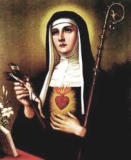
of the second nocturn of the feast. To St. Mechtilde (d. 1298) and St. Gertrude (d. 1302) it was a familiar devotion which
was translated into many beautiful prayers and exercises. What deserves special mention is the vision of St. Gertrude on
the feast of St. John the Evangelist, as it forms an epoch in the history of the devotion. Allowed to rest her head near the
wound in the Saviour's she heard the beating of the Divine Heart and asked John if, on the night of the Last Supper, he
too had felt these delightful pulsations, why he had never spoken of the fact. John replied that this revelation had been
reserved for subsequent ages when the world, having grown cold, would have need of it to rekindle its love ("Legatus
divinae pietatis", IV, 305; "Revelationes Gertrudianae", ed. Poitiers and Paris, 1877).
(3) From the thirteenth to the sixteenth century, the devotion was propagated but it did not seem to have developed in itself. It was
everywhere practised by privileged souls, and the lives of the saints and annals of different religious congregations, of the Franciscans,
Dominicans, Carthusians, etc., furnish many examples of it. It was nevertheless a private, individual devotion of the mystical order.
Nothing of a general movement had been inaugurated, unless one would so regard the propagation of the devotion to the Five
Wounds, in which the Wound in the Heart figured most prominently, and for the furtherance of which the Franciscans seem to have
laboured.
(4) It appears that in the sixteenth century, the devotion took an onward step and passed from the domain of mysticism into that of
Christian asceticism. It was constituted an objective devotion with prayers already formulated and special exercises of which the value
was extolled and the practice commended. This we learn from the writings of those two masters of the spiritual life, the pious
Lanspergius (d. 1539) of the Carthusians of Cologne, and the devout Louis of Blois (Blosius; 1566), a Benedictine
and Abbot of Liessies in Hainaut. To these may be added St. John of Avila (d. 1569) and St. Francis de Sales, the
latter belonging to the seventeenth century.
(5) From that time everything betokened an early bringing to light of the devotion. Ascetic writers spoke of it,
especially those of the Society of Jesus, Alvarez de Paz, Luis de la Puente, Saint-Jure, and Nouet, and there still
exist special treatises upon it such as Father Druzbicki's (d. 1662) small work, "Meta Cordium, Cor Jesu". Amongst
the mystics and pious souls who practised the devotion were St. Francis Borgia, Blessed Peter Canisius, St.
Aloysius Gonzaga, and St. Alphonsus Rodriguez, of the Society of Jesus; also Venerable Marina de Escobar (d.
1633), in Spain; the Venerable Madeleine St. Joseph and the Venerable Marguerite of the Blessed Sacrament, Carmelites, in France;
Jeanne de S. Mathieu Deleloe (d. 1660), a Benedictine, in Belgium; the worthy Armelle of Vannes (d. 1671); and even in Jansenistic or
worldly centres, Marie de Valernod (d. 1654) and Angelique Arnauld; M. Boudon, the great archdeacon of Evreux, Father Huby, the
appostle of retreats in Brittany, and, above all, the Venerable Marie de l'Incarnation, who died at Quebec in 1672. The Visitation seemed
to be awaiting St. Margaret Mary; its spirituality, certain intuitions of St. Francis de Sales, the meditations of Mère l'Huillier (d. 1655),
the visions of Mother Anne-Marguerite Clement (d. 1661), and of Sister Jeanne-Benigne Gojos (d. 1692), all paved the way. The image
of the Heart of Jesus was everywhere in evidence, which fact was largely due to the Franciscan devotion to the Five Wounds and to the
habit formed by the Jesuits of placing the image on their title-page of their books and the walls of their churches.
(6) Nevertheless, the devotion remained an individual or at least a private devotion. It was reserved to Blessed Jean Eudes (1602-1680)
to make it public, to honour it with an Office, and to establish a feast for it. Père Eudes was above all the apostle of the Heart of Mary;
but in his devotion to the Immaculate Heart there was a share for the Heart of Jesus. Little by little the devotion to the Sacred Heart
became a separate one, and on 31 August, 1670, the first feast of the Sacred Heart was celebrated with great solemnity in the Grand
Seminary of Rennes. Coutances followed suit on 20 October, a day with which the Eduist feast was thenceforth to be connected. The
feast soon spread to other dioceses, and the devotion was likewise adopted in various religious communities. Here and there it came
into contact with the devotion begun at Paray, and a fusion of the two naturally resulted.
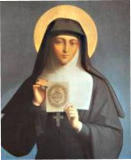
(7) It was to Margaret Mary Alacoque (1647-1690), a humble Visitandine of the monastery at Paray-le Monial, that Christ chose to
reveal the desires of His Heart and to confide the task of imparting new life to the devotion. There is nothing to indicated that this pious
religious had known the devotion prior to the revelations, or at least that she had paid any attention to it. These revelations were
numerous, and the following apparitions are especially remarkable: that which occurred on the feast of St. John, when Jesus permitted
Margaret Mary, as He had formerly allowed St. Gertrude, to rest her head upon His Heart, and then disclosed
to her the wonders of His love, telling her that He desired to make them known to all mankind and to diffuse
the treasures of His goodness, and that He had chosen her for this work (27 Dec., probably 1673); that, probably
distinct from the preceding, in which He requested to be honoured under the figure of His Heart of flesh; that,
when He appeared radiant with love and asked for a devotion of expiatory love—frequent Communion,
Communion on the First Friday of the month, and the observance of the Holy Hour
(probably June or July, 1674); that known as the "great apparition" which took place
during the octave of Corpus Christi, 1675, probably on 16 June, when He said, "Behold
the Heart that has so loved men ... instead of gratitude I receive from the greater part (of
mankind) only ingratitude ...", and asked her for a feast of reparation of the Friday after the octave of Corpus
Christi, bidding her consult Father de la Colombière, then superior of the small Jesuit house at Paray; and finally,
those in which solemn homage was asked on the part of the king, and the mission of propagating the new
devotion was especially confided to the religious of the Visitation and the priests of the Society of Jesus. A few
days after the "great apparition", of June, 1675, Margaret Mary made all known to Father de la Colombière, and
the latter, recognizing the action of the spirit of God, consecrated himself to the Sacred Heart, directed the holy Visitandine to write an
account of the apparition, and made use of every available opportunity discreetly to circulate this account through France and England.
At his death, 15 February 1682, there was found in his journal of spiritual retreats a copy in his own handwriting of the account that he
had requested of Margaret Mary, together with a few reflections on the usefulness of the devotion. This journal, including the account
and a beautiful "offering" to the Sacred Heart, in which the devotion was well explained, was published at Lyons in 1684. The little book
was widely read, even at Paray, although not without being the cause of "dreadful confusion" to Margaret Mary, who, nevertheless,
resolved to make the best of it and profited by the book for the spreading of her cherished devotion. Moulins, with Mother de
Soudeilles, Dijon, with Mother de Saumaise and Sister Joly, Semur, with Mother Greyfie, and even Paray, which had at first resisted,
joined the movement. Outside of the Visitandines, priests, religious, and laymen espoused the cause, particularly a Capuchin, Margaret
Mary's two brothers, and some Jesuits, among the latter being Fathers Croiset and Gallifet, who were destined to do so much for the
devotion.
(8) The death of Margaret Mary, 17 October 1690, did not dampen the ardour of those interested; on the contrary, a short account of her
life published by Father Croiset in 1691, as an appendix to his book "De la Devotion au Sacre C&oeligur", served only to increase it. In
spite of all sorts of obstacles, and of the slowness of the Holy See, which in 1693 imparted indulgences to the Confraternities of the
Sacred Heart and, in 1697, granted the feast to the Visitandines with the Mass of the Five Wounds, but refused a feast common to all,
with special Mass and Office, the devotion spread, particularly in religious communities. The Marseilles plague, 1720, furnished
perhaps the first occasion for a solemn consecration and public worship outside of religious communities. Other cities of the South
followed the example of Marseilles, and thus the devotion became a popular one. In 1726 it was deemed advisable once more to
importune Rome for a feast with a Mass and Office of its own, but, in 1729, Rome again refused. However, in 1765, it finally yielded and
that same year, at the request of the queen, the feast was received quasi officially by the episcopate of France. On all sides it was asked
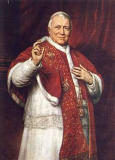
for and obtained, and finally, in 1856, at the urgent entreaties of the French bishops, Pope Pius IX extended the feast to the universal
Church under the rite of double major. In 1889 it was raised by the Church to the double rite of first class. The acts of consecration and
of reparation were everywhere introduced together with the devotion. Oftentimes, especially since about 1850, groups, congregations,
and States have consecrated themselves to the Sacred Heart, and, in 1875—this consecration was made throughout the Catholic world.
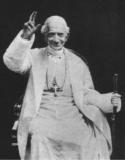
Still the pope did not wish to take the initiative or to intervene. Finally, on 11 June, 1899, by order of Leo XIII, and with the formula
prescribed by him, all mankind was solemnly consecrated to the Sacred Heart. The idea of this act, which Leo XIII called "the great act"
of his pontificate, had been proposed to him by a religious of the Good Shepherd from Oporto (Portugal) who said
that she had received it from Christ Himself. She was a member of the Drost-zu-Vischering family, and known in
religion as Sister Mary of the Divine Heart. She died on the feast of the Sacred Heart, two days before the
consecration, which had been deferred to the following Sunday. Whilst alluding to these great public
manifestations we must not omit referring to the intimate life of the devotion in souls, to the practices connected
with it, and to the works and associations of which it was the very life. Moreover, we must not overlook the social
character which it has assumed particularly of late years. The Catholics of France, especially,
cling firmly to it as one of their strongest hopes of ennoblement and salvation.
Transcribed by Christine J. Murray
Dedicated to Mary Christie and John A. Hardon, S.J.
From the Catholic Encyclopedia
Copyright © 1913 Encyclopedia Press, Inc.
Electronic Copyright © 1996 New Advent, Inc.
All Rights Reserved