May 13, 2015
5V

“Come, My Heart is an abyss of Mercy, Love and Tenderness!” “My Sacred Heart is your Heaven!”
“Look at My Heart .... look, have I not opened the gate of My Heart for you!”




Eucharistic Miracles
The Eucharistic Miracles of the World
(taken from website The Real Presence.org)
Presented by The Real Presence Eucharistic Education and Adoration Association
Our late and most beloved Pope John Paul II called us repeatedly to take up the work of the New
Evangelization, that is, to bring Christ to a totally secularized world by teaching, celebrating and living our
Catholic faith as if for the first time. He constantly directed us to the Blessed Virgin Mary and to the saints, also
of our own time, as examples of the holiness of life, to which the New Evangelization calls us for the salvation
of our souls and the transformation of our world, and as friends and intercessors in meeting the many
challenges of leading a holy life. He urged us to be one with our Blessed Mother and the whole communion of
saints in looking upon the Face of Christ, in hearing His invitation to put out into the deep (Lk 5:4), and in
putting aside our doubts and fears in order to bring Him to the world.
The last three major documents of Pope John Paul II’s pontificate form a unity in presenting to us the program
of the New Evangelization and in urging us to embrace it with the enthusiasm and energy of the first disciples
and the first missionaries to our continent and nation. They are the Apostolic Letter Novo millennio ineunte,
“At the Close of the Great Jubilee of the Year 2000” (January 6, 2001); the Apostolic Letter Rosarium Virginis
Mariae, “On the Most Holy Rosary” (October 16, 2002); and the Encyclical Letter Ecclesia de Eucharistia, “On
the Eucharist in Its Relationship to the Church” (April 17, 2003 – Holy Thursday).
The goal of the New Evangelization is, as Pope John Paul II explains in the Encyclical Letter Ecclesia de Eucharistia, “to rekindle” our loving wonder
before the Holy Eucharist, the great Mystery of Faith. Let us read again his words to us:
I would like to rekindle this Eucharistic “amazement” by the present Encyclical Letter, in continuity with the Jubilee heritage which I have left to the
Church in the Apostolic Letter Novo millennio ineunte and its Marian crowning, Rosarium Virginis Mariae. To contemplate the Face of Christ, and
to contemplate it with Mary, is the “program” which I have set before the Church at the dawn of the Third Millennium, summoning her to put out
into the deep on the sea of history with the enthusiasm of the New Evangelization. To contemplate Christ involves being able to recognize Him
wherever He manifests Himself, in His many forms of presence, but above all in the living sacrament of His Body and His Blood. The Church draws
her life from Christ in the Eucharist; by Him she is fed and by him she is enlightened (Ecclesia de Eucharistia, n. 6).
The Holy Eucharist is the source at which Christ’s life is nourished within us with the incomparable food which is His Body, Blood, Soul and
Divinity. The Holy Eucharist is the highest expression of our life in Christ, for it unites us sacramentally to Christ in the Sacrifice of the Cross, which
is made always new in the celebration of the Holy Mass.
In the last years of his pontificate, our late and beloved Pontiff directed his attention, above all else, to teaching us about the Holy Eucharist, and to
restoring the discipline by which the Holy Mass is celebrated, and the Holy Eucharist is reposed in the tabernacle and worshiped outside of the Holy
Mass. In the final year of his service as Vicar of Christ, he called us to observe the Year of the Eucharist (October 2004 to October 2005). The Year of
the Eucharist began with the International Eucharistic Congress, held at Guadalajara in Mexico, and concluded with the Ordinary Assembly of the
Synod Bishops, “The Eucharist: Source and Summit of the Life and the Mission of the Church,” at which Pope John Paul II’s successor, Pope Benedict
XVI, presided.
As we carry forward the work of the New Evangelization, the Eucharistic Mystery is the source of our direction and strength. At the same time, the
deeper knowledge and love of the Holy Eucharist, born of our loving wonder and “amazement” at the mystery of God’s love for us in His Son, Jesus
Christ, is our goal. To assist us in reawakening and deepening our love of the Holy Eucharist, The Real Presence Eucharistic Education and
Adoration Association, an apostolate founded by the late Father John A. Hardon, S.J., tireless apostle and catechist of the Eucharist, has worked with
the Pontifical Academy Cultorum Martyrum (founded to promote and deepen the veneration of the Holy Martyrs), to present, in English, the story
of 126 miracles associated with faith in and worship of the Most Blessed Sacrament. Each of the miracles is venerated at a shrine, all of which have
been approved by the Diocesan Bishop and some of which have the approval of the Holy See. Cooperating with the Pontifical Academy, the Real
Presence Eucharistic Education and Adoration Association has made available in English the Vatican International Exhibit, The Eucharistic Miracles
of the World.
The miracles presented in the Vatican International Exhibit, like all miracles, are gifts from God “to witness to some truth or to testify to someone’s
sanctity” (Father John A. Hardon, S.J., Modern Catholic Dictionary, p. 352). It should not surprise us that God has granted so many miracles to
deepen our knowledge and love of His greatest gift to us, the gift of the Body and Blood of His only-begotten Son, our Lord Jesus Christ, as the
Heavenly Food of our earthly pilgrimage and the Medicine of eternal life.
The Eucharistic Miracles of the World provides a wonderful service to the work of the New Evangelization. The popular devotion associated with
each miracle is a most worthy vehicle of the New Evangelization. As Pope Paul VI taught us, in his Magna Carta on the New Evangelization, the
Apostolic Exhortation Evangelii nuntiandi, “On Evangelization in the Modern World” (December 8, 1975), popular piety, “if it is well oriented, above
all by a pedagogy of evangelization,” offers a great good to the life of the Church. Describing the fruits of popular piety, Pope Paul VI observed:
It manifests a thirst for God which only the simple and poor can know. It makes people capable of generosity and sacrifice even to the point of
heroism, when it is a question of manifesting belief. It involves an acute awareness of profound attributes of God: fatherhood, providence, loving
and constant presence. It engenders interior attitudes rarely observed to the same degree elsewhere: patience, the sense of the Cross in daily life,
detachment, openness to others, devotion (Evangelii nuntiandi, n. 48d).
The piety and devotion surrounding the Eucharistic miracles down the Christian centuries has borne its richest fruit in the total love of our Lord
Jesus Christ in the Blessed Sacrament and in the readiness to give one’s life for love of our Eucharistic Lord. The devout study of the Eucharistic
miracles inspires in us a deeper awareness and more ardent love of our Lord’s Real Presence with us in the Holy Eucharist.
With the publication of The Eucharistic Miracles of the World, the remarkable Vatican International Exhibit of the same title can be brought into the
homes of the faithful, into parishes and schools, and into the hands of all who desire to come to know or to ponder anew the Mystery of Faith, which
is inexhaustible in its richness for our life and salvation. It is my hope that the study of The Eucharistic Miracles of the World will inspire in every
reader a greater holiness of life, a life patterned on and nourished by the Eucharistic Sacrifice of Christ. In a particular way, it is my hope that it will
lead all to a deeper appreciation of the call which our Lord gives to each of us, the call to “put out into the deep,” especially by embracing our
vocation in life with an undivided heart. For children and young people, may it lead them to reflect upon God’s call in their lives and especially to
ask God whether He may be calling them to the ordained priesthood or to the consecrated life.
What can bring us greater joy and peace than to draw near to our Lord in the Most Blessed Sacrament. May both the Vatican International Exhibit,
The Eucharistic Miracles of the World, and the book which memorializes it be worthy and effective instruments of the New Evangelization. May
they lead us to Christ in the Holy Eucharist, so that, one with Christ, we can bring Him to our world.
Adoremus in aeternum Sanctissimum Sacramentum.
The Most Reverend Raymond Leo Burke
Archbishop of Saint Louis
August 6, 2006 – Feast of the Transfiguration of the Lord



Eucharistic Miracles
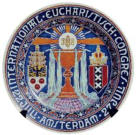
Amsterdam, The Netherlands (Holland), AD 1345
In 1345, a man who was a devout Catholic became very ill. He told his family he would like to receive Holy Viaticum. The
family notified the pastor of the then known Old Church. The priest, after administering the sacrament, advised the family,
if the ill man threw up (which he was known to do after taking nourishment) they were to empty the contents in the fire.
The man threw up and the family did what they were advised to do by the priest, they threw the contents in the fire in the
sick room. This incident occurred on March 12th.
Early the next morning, one of the women went to rake the fire and she noticed in the middle of the grate, the Blessed
Sacrament in the form of host. A light surrounded it. The woman became upset and immediately put her hand in the fire to
rescue the host. This she did without any ill effects to herself. She did not burn her hand. The woman was surprised to find
the host was cold! She immediately called in a neighbor and asked her to take the Sacred Host to her home. The neighbor took a clean cloth, placed
the host on it and locked it in a box. She then took it home. When the husband of the woman who found the host heard what had taken place, he
requested to see it. He tried to lift it off the white cloth it rested on but the Sacred Particle resisted as if to say it did not want to be touched by this
man's hands.
A priest was then summoned who took the host and placed it in a pyx. When he went to wash the cloth which held the Blessed Sacrament and return
it to the original box, he noticed the pyx was upset and the host was gone!
The next morning the neighbor returned for her original box and cloth. When she opened the locked box she once again found the Sacred Host in it!
There was then no doubt that Our Lord wanted this miracle to made known! The priest notified the clergy of Amsterdam and a procession was held
to carry the host to the church.
The home of the sick man soon became a chapel and as early as 1360 public processions and pilgrims traveled to the site of the miracle.
On May 25, 1452, a large conflagration broke out which left three fourths of the city in ruins. It was during this time, the chapel known as the Holy
Room became subject to the flames. Strangely, the monstrance containing the Miraculous Host, (which had been brought over to the chapel from the
old church) was spared. In 1456, a new Holy Room was built surrounded by a beautiful church.
Many pilgrims went to visit the shrine seeking cures and spiritual help. One pilgrim, archduke Maximilian, later a Roman Emperor, came seeking a
cure in 1480. God heard his prayer and he was cured. In thanksgiving, the archduke dedicated a beautiful window to the Holy Room.
By the second half of the sixteenth century, Catholics in Amsterdam fell under persecution of the Protestants. The Holy Room fell under Protestant
rule. In 1910, rather than sell the property to the Catholics, the chapel was torn down. However, devotion to this Eucharistic Miracle still takes place
on March 12th at the church nearest the site.


Lanciano, Italy 8th Century AD
Ancient Anxanum, the city of the Frentanese, has contained for over twelve centuries the first and greatest Eucharistic
Miracle of the Catholic Church. This wondrous Event took place in the 8th century A.D. in the little Church of St.
Legontian, as a divine response to a Basilian monk's doubt about Jesus' Real Presence in the Eucharist.
During Holy Mass, after the two-fold consecration, the host was changed into live Flesh and the wine was changed into
live Blood, which coagulated into five globules, irregular and differing in shape and size.
The Host-Flesh, as can be very distinctly observed today, has the same dimensions as the large host used today in the
Latin church; it is light brown and appears rose-colored when lighted from the back. The Blood is coagulated and has an
earthy color resembling the yellow of ochre.
Various ecclesiastical investigation ("Recognitions") were conducted since 1574.
In 1970-'71 and taken up again partly in 1981 there took place a scientific investigation by the most illustrious scientist Prof. Odoardo Linoli, eminent
Professor in Anatomy and Pathological Histology and in Chemistry and Clinical Microscopy. He was assisted by Prof. Ruggero Bertelli of the
University of Siena.
The analyses were conducted with absolute and unquestionable scientific precision and they were documented with a series of microscopic
photographs. These analyses sustained the following conclusions:
The Flesh is real Flesh. The Blood is real Blood. The Flesh and the Blood belong to the human species. The Flesh consists of the muscular tissue of the
heart. In the Flesh we see present in section: the myocardium, the endocardium, the vagus nerve and also the left ventricle of the heart for the large
thickness of the myocardium. The Flesh is a "HEART" complete in its essential structure.
The Flesh and the Blood have the same blood-type: AB (Blood-type identical to that which Prof. Baima Bollone uncovered in the Holy Shroud of
Turin.
In the Blood there were found proteins in the same normal proportions (percentage-wise) as are found in the sero-proteic make-up of the fresh
normal blood. In the Blood there were also found these minerals: chlorides, phosphorus, magnesium, potassium, sodium and calcium. The
preservation of the Flesh and of the Blood, which were left in their natural state for twelve centuries and exposed to the action of atmospheric and
biological agents, remains an extraordinary phenomenon.
In conclusion, it may be said that Science, when called upon to testify, has given a certain and thorough response as regards the authenticity of the
Eucharistic Miracle of Lanciano.
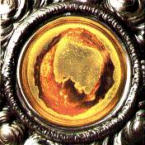


Sienna, Italy, AD 1730
The second Eucharistic miracle of Sienna has roots in the 13th century when special services and festivities were
introduced in honor of the feast of the Assumption of the Blessed Virgin Mary. These observances became
traditional and were still conducted at the time of the miracle. So it was that on August 14, 1730, during devotions
for the vigil of the feast, while most of the Sienese population and the clergy of the city were attending these
services, thieves entered the deserted Church of St. Francis. Taking advantage of the friars' absence, they made for
the chapel where the Blessed Sacrament was kept, picked the lock to the tabernacle and carried away the golden
ciborium containing consecrated Hosts.
The theft went undiscovered until the next morning, when the priest opened the tabernacle at the Communion of
the Mass. Then later, when a parishioner found the lid of the ciborium lying in the street, the suspicion of sacrilege
was confirmed. The anguish of the parishioners forced the cancellation of the traditional festivities for the feast of
Our Lady's Assumption. The Archbishop ordered public prayers of reparation, while the civil authorities began a
search for the consecrated Hosts and for the scoundrel who had taken them.
Two days later, on August 17, while praying in the Church of St. Mary of Provenzano, a priest's attention was
directed to something white protruding from the offering box attached to his prie dieu. Realizing that it was a
Host, he informed the other priests of the church, who in turn notified the Archbishop and the friars of the Church of St. Francis.
When the offering box was opened, in the presence of local priests and the representative of the Archbishop, a large number of Hosts were found,
some of them suspended by cobwebs. The Hosts were compared with some unconsecrated ones used in the Church of St. Francis, and proved to be
exactly the same size and to have the same mark of the irons upon which they were baked. The number of Hosts corresponded exactly to the number
the Franciscan friars had estimated were in the ciborium -- 348 whole Hosts and six halves.
Since the offering box was opened but once a year, the Hosts were covered with the dust and debris that had collected there. After being carefully
cleaned by the priests, they were enclosed in a ciborium and placed inside the tabernacle of the main altar of the Church of St. Mary. The following
day, in the company of a great gathering of townspeople, Archbishop Alessandro Zondadari carried the Sacred Hosts in solemn procession back to
the Church of St. Francis.
During the two centuries that followed it has sometimes been wondered why the Hosts were not consumed by a priest during Mass, which would
have been the ordinary procedure in such a case. While there is no definite answer, there are two theories. One explanation is that crowds of people
from both Sienna and neighboring cities gathered in the church to offer prayers of reparation before the sacred particles, forcing the priests to
conserve them for a time. The other reason the priests did not consume them might well have been because of their soiled condition. While the Hosts
were superficially cleaned after their discovery, they still retained a great deal of dirt. In such cases it is not necessary to consume consecrated Hosts,
but it is permitted to allow them to deteriorate naturally, at which time Christ would no longer be present.
To the amazement of the clergy, the Hosts did not deteriorate, but remained fresh and even retained a pleasant scent. With the passage of time the
Conventual Franciscans became convinced that they were witnessing a continuing miracle of preservation.
Fifty years after the recovery of the stolen Hosts, an official investigation was conducted into the authenticity of the miracle. The Minister General of
the Franciscan Order, Father Carlo Vipera, examined the Hosts on April 14, 1780, and upon tasting one of them he found it fresh and incorrupt. Since
a number of the Hosts had been distributed during the preceding years, the Minister General ordered that the remaining 230 particles be placed in a
new ciborium and forbade further distribution.
A more detailed investigation took place in 1789 by Archbishop Tiberio Borghese of Sienna with a number of theologians and other dignitaries. After
examining the Hosts under a microscope, the commission declared that they were perfectly intact and showed no sign of deterioration. The three
Franciscans who had been present at the previous investigation, that of 1780, were questioned under oath by the Archbishop. It was then reaffirmed
that the Hosts under examination were the same ones stolen in 1730.
As a test to further confirm the authenticity of the miracle, the Archbishop, during this 1789 examination, ordered several unconsecrated hosts to be
placed in a sealed box and kept under lock in the chancery office. Ten years later these were examined and found to be not only disfigured, but also
withered. In 1850, 61 years after they were placed in a sealed box, these unconsecrated hosts were found reduced to particles of a dark yellow color,
while the consecrated Hosts retained their original freshness.
Other examinations were made at intervals over the years, the most significant being that of 1914, undertaken on the authority of Pope St. Pius X. For
this inquiry the Archbishop selected a distinguished panel of investigators, which included scientists and professors from Sienna and Pisa, as well as
theologians and Church officials.
Acid and starch tests performed on one of the fragments indicated a normal starch content. The conclusions reached from microscopic tests indicated
that the Hosts had been made of roughly sifted wheat flour, which was found to be well preserved.
The commission agreed that unleavened bread, if prepared under sterile conditions and kept in an airtight, antiseptically cleaned container, could be
kept for an extremely long time. Unleavened bread prepared in a normal fashion and exposed to air and the activity of micro-organisms would
remain intact for no more than a few years. It was concluded that the stolen Hosts had been both prepared without scientific precautions and kept
under ordinary conditions which should have caused their decay more than a century before. The commission concluded that the preservation was
extraordinary, ". . . e la scienza stessa che proclama qui lo straordinario."
Professor Siro Grimaldi, professor of chemistry at the University of Sienna and director of the Municipal Chemical Laboratory, as well as the holder
of several other distinguished positions in the field of chemistry, was the chief chemical examiner of the holy particles in 1914. Afterward, he gave
elaborate statements concerning the miraculous nature of the Hosts, and wrote a book about the miracle entitled Uno Scienziato Adora (A Scientific
Adorer). In 1914 he declared:
The holy Particles of unleavened bread represent an example of perfect preservation ... a singular phenomenon that inverts the natural law of the
conservation of organic material. It is a fact unique in the annals of science.
In 1922 another investigation was conducted -- this one in the presence of Cardinal Giovanni Tacci, who was accompanied by the Archbishop of
Sienna and the Bishops of Montepulciano, Foligno and Grosseto. Again the results were the same: the Hosts tasted like unleavened bread, were
starchy in composition and were completely preserved.
In 1950 the miraculous Hosts were taken from the old ciborium and placed in a more elaborate and costly one, which caught the eye of another thief.
Thus, despite the precautions of the clergy, another sacrilegious theft occurred on the night of August 5, 1951. This time the thief was considerate
enough to take only the container and left the Hosts in a corner of the tabernacle. After counting 133 Hosts, the Archbishop himself sealed them in a
silver ciborium. Later, after being photographed, they were placed in an elaborate container which replaced the one that had been stolen.
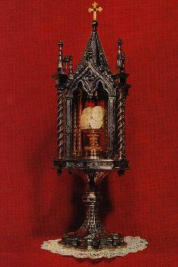
The miraculously preserved Hosts are displayed publicly on various occasions, but especially on the 17th of each month, which commemorates the
day they were found after the first theft in 1730. On the feast of Corpus Christi the Sacred Hosts are placed in their processional monstrance and
triumphantly carried in procession from the church through the streets of the town, an observance in which the whole populace participates.
Among many distinguished visitors who have adored the Hosts was St. John Bosco. They were likewise venerated by Pope John XXIII, who signed
the album of visitors on May 29, 1954, when he was still the Patriarch of Venice. And although unable to visit the miraculous Hosts, Popes Pius X,
Benedict XV, Pius Xl and Pius Xll issued statements of profound interest and admiration.
With a unanimous voice, the faithful, priests, bishops, cardinals and popes have marveled at and worshiped the holy Hosts, recognizing in them a
permanent miracle, both complete and perfect, that has endured for over 250 years.
By this miracle the Hosts have remained whole and shiny, and have maintained the characteristic scent of unleavened bread. Since they are in such a
perfect state of conservation, maintaining the appearances of bread, the Catholic Church assures us that although they were consecrated in the year
1730, these Eucharistic Hosts are still really and truly the Body of Christ. The miraculous Hosts have been cherished and venerated in the Basilica of
St. Francis in Sienna for over 250 years.
OTHER PLACES BLESSED WITH EUCHARISTIC MIRACLES
3 rd - 5 th Century SCETE, Egypt
6 th Century JORDAN/ARABIAN DESERT - St. Mary of Egypt, Egypt
7 th Century ROME, Italy (part 1)
7 th Century ROME, Italy (part 2)
720 AD VALENCIA, Spain (part 1) (The Holy Grail)
720 AD VALENCIA, Spain (part 2) (The Holy Grail)
750 AD LANCIANO, Italy (part 1)
750 AD LANCIANO, Italy (part 2)
1010 AD IVORRA, Spain (part 1)
1010 AD IVORRA, Spain (part 2)
1055 AD WEINGARTEN (part 1), Germany
1055 AD WEINGARTEN (part 2), Germany
11 th Century SAINT PETER DAMIAN, Italy
11 th Century TRANI, Italy
1171 AD FERRARA, Italy
1194 AD AUGSBURG, Germany
1125 AD BETTBRUNN, Germany
1203 AD BRUGES, Belgium
1216 AD BENNINGEN, Germany
1222-1465 AD MEERSSEN, Netherland
1225 AD SANTAREM, Portugal (Or 1247)
1227 AD RIMINI, Italy
1228 AD ALATRI, Italy
1230-1595 AD FLORENCE, Italy
1231 AD CARAVACA DE LA CRUZ, Spain
1239 AD DAROCA, Spain (part 1)
1239 AD DAROCA, Spain (part 2)
1240 AD ASSISI (Saint Clare), Italy
1247 AD SANTARÉM, Portugal (part 1)
1247 AD SANTARÉM, Portugal (part 2)
1251 AD SAINT JOHN OF THE ABBESSES, Spain
1254 AD DOUAI, France
1255 AD REGENBURG, Germany
1257 AD NEUVY SAINT SÉPULCRE, France
1264 AD BOLSENA, Italy (part 1)
1264 AD BOLSENA, Italy (part 2)
1273-1280 AD OFFIDA, Italy
1280 AD KRANENBURG, District of Kleve, Germany
1290 AD GLOTOWO, Poland
1290 AD PARIS, France (part 1)
1290 AD PARIS, France (part 2)
1294 AD GRUARO (Valvasone), Italy
1297 AD GERONA, Spain
1300 AD BREDA-NIERVAART, Netherland
1300 AD O'CEBREIRO, Spain
1310 AD FIECHT, Austria
1317 AD HERKENRODE-HASSELT, Belgium
1330 AD WALLDURN, Germany
1330 AD CASCIA, Italy
1331 AD BLANOT, France
1342 AD STIPHOUT, Netherland
1345 AD KRAKOW, Poland
1345 AD AMSTERDAM, Netherland (part 1)
1345 AD AMSTERDAM, Netherland (part 2)
1348 AD ALBORAYA-ALMACERA, Spain (part 1)
1348 AD ALBORAYA-ALMACERA, Spain (part 2)
1356 AD MACERATA, Italy
1370 AD BRUSSELS, Belgium
1370 AD CIMBALLA, Spain
1374 AD LUTTICH (Corpus Domini), Belgium
1374 AD MIDDLEBURG-LOVANIO, Belgium
1380 AD BOXTEL-HOOGSTRATEN, Netherland
1383 AD WILSNACK, Germany
1384 AD SEEFELD, Austria
1392 AD MONCADA, Spain
1399 AD POZNAN, Poland
1400 AD BOXMEER, Netherland
1405 AD BOIS-SEIGNEUR-ISAAC, Belgium (1405)
1411 AD WEITEN-RAXENDORF, Austria
1411 AD LUDBREG, Croatio
1411 AD LUDBREG, Croatio
1412 AD HERENTALS, Belgium
1412 AD BAGNO DI ROMAGNA, Italy
1417 AD ERDING, Germany
1420 AD GUADALUPE, Spain
1421 AD BERGEN, Netherland
1427 AD ZARAGOZA, Spain
1429 AD ALKMAAR, Netherland
1430 AD DIJON, France
1433 AD AVIGNON, France (part 1)
1433 AD AVIGNON, France (part 2)
1447 AD ETTISWIL, Switzerland
1453 AD TURIN, Italy (part 1)
1453 AD TURIN, Italy (part 2)
1461 AD LA ROCHELLE, France
1472 AD VOLTERRA, Italy
1533 AD MARSEILLE-EN-BEAUVAIS, France
1533 AD PONFERRADA, Spain
1535 AD ASTI, Italy
1560 AD MORROVALLE, Italy
1568 AD ALCOY, Spain
1570 AD VEROLI, Italy
1572 AD GORKUM-EL ESCORIAL, Spain
1597 AD ALCALA, Spain 1597
1604 AD MOGORO, Italy
1608 AD FAVERNEY, France
1610 AD ROME, Italy
1630 AD CANOSIO, Italy
1631 AD DRONERO, Italy
1631 AD SAN MAURO LA BRUCA, Italy
1640 AD TURIN, Italy
1643 AD PRESSAC, France
1649 AD ETEN, Peru
1656 AD CAVA DEI TIRRENI, Italy
1657 AD MONTSERRAT, Spain
1668 AD LES ULMES, France
1718 AD ASTI, Italy
1730 AD SIENNA, Italy
1732 AD SCALA, Italy
1750 AD SIENA, Italy
1772 AD PATIERNO (Naples), Italy
1822 AD BORDEAUX, France
1824 AD ONIL, Spain (part 1)
1824 AD ONIL, Spain (part 2)
1902 AD MORNE-ROUGE, Carribean Island of Martinique
1902 AD SAINT ANDRÉ DE LA RÉUNION, Island of La Réunion.
1906 AD TUMACO, Columbia
1907 AD SILLA, Spain
1948 AD ROSANO, Italy
2001 AD CHIRATTAKONAM, India