


May 13, 2015
5V

“Come, My Heart is an abyss of Mercy, Love and Tenderness!” “My Sacred Heart is your Heaven!”
“Look at My Heart .... look, have I not opened the gate of My Heart for you!”

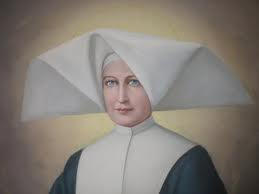
St. Catherine Labouré
SAINT CATHERINE LABOURE - FEASTDAY NOVEMBER 28 (click)
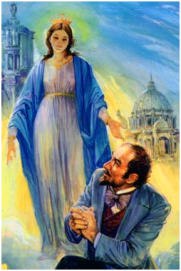
THE JEW ALPHONSE RATISBONNE AND THE MIRACULOUS MEDAL (1842) (click)
SAINT CATHERINE LABOURE - FEASTDAY NOVEMBER 28
(taken from Marypages)
Saint Catherine Laboure
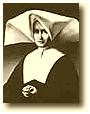
Saint Catherine, was born as Zoe Laboure at Fain-lès-Moutiers, Burgundy, France to the farmer Pierre Labouré and Louise Laboure
as the ninth of eleven children on May 2, 1806. From an early age felt a call to the religious life. When Catherine was nine years old,
her saintly mother died on October 9, 1815. After the burial service, little Catherine retired to her room, stood on a chair, took our
Lady's statue from the wall, kissed it, and said: "Now, dear Lady, you are to be my mother." On January 25, 1818, Catherine made her
First Communion. One day she had a dream in which a priest said to her: "My daughter, you may flee me now, but one day you will
to come to me. Do not forget that God has plans for you." Sometime later, while visiting a hospital of the Daughters of Charity at
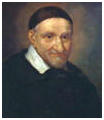
Chatillon-sur-Seine, she noticed a priest's picture on the wall. She asked a sister who he might be, and was told: "Our Holy Founder
Saint Vincent de Paul." This was the same priest Catherine had seen in the dream. Catherine knew she was in the right place.
Later, on January 1830, Catherine began her postulancy at Chatillon. On Wednesday, April 21, 1830, Catherine Labouré entered the novitiate of the
Daughters of Charity, located at their motherhouse, Rue du Bac 140, Paris. taking the name Catherine. On the eve of the Feast of Saint Vincent de
Paul, July 19, the Sister Superior spoke to the novices about the virtues of their Holy Founder and gave each of the novices a piece of cloth from the
holy founder's surplice. Because of her extreme love, Catherine split her piece down the middle, swallowing half and placing the rest in her prayer
book. She earnestly prayed to Saint Vincent that she might, with her own eyes, see the Mother of God.
1
st
apparition of the Blessed Virgin: 19th July, 1830 Chapel Rue du Bac 140, Paris
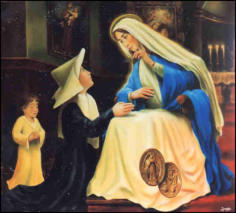
It is 11.30 pm; Sister Catherine Laboure (24 years old) wakes up as she hears her name called three times. She opens the curtains of her cell and sees
her Guardian Angel in de form of a 5 year old child. He says: "follow me to the chapel, where the Virgin Mary awaits you". Catherine
Laboure hastily dresses herself and follows him to the chapel. The chapel is lit as for midnight-Mass, but she can't see the Blessed
Virgin. She then kneels and prays. After half an hour her guardian angel says: "there is the Blessed Virgin Mary". Catherine Laboure
hears a rustle like that of silk and to the left of St. Joseph she sees the Blessed Virgin Mary descend and sit herself on the chair of the
Priest. Within a moment she is on her knees in front of the Blessed Virgin, with her hands confidently folded on Mary's knees. This is
the beginning of a two hour long conversation. The Blessed Virgin Mary tells her that God will charge her with a mission. In the
process she will experience many difficulties. The Blessed Virgin already speaks of bad times ahead. The whole world will be
plunged into confusion through all sorts of incidents. The Cross will be treated with contempt; it will be cast to earth. The side of our
Lord will be pierced again. The Blessed Virgin says this with a very sorrowful look on her face. Encouragingly though, she adds:
"but come to the foot of this altar and here graces will be bestowed upon all,
who ask with confidence and fervour. they will be given to the rich and to the poor"
2
nd
apparition of the Blessed Virgin: 27th November, 1830 Chapel Rue du Bac 140, Paris
It is 5.30pm, and the Sisters are in the chapel for the hour of Meditation. Suddenly Catherine Laboure hears, to her right, the same rustle as before;
it is the Blessed Virgin Mary. She stops to the left near the painting of St. Joseph. This whole apparition is conducted in scenes and sign-
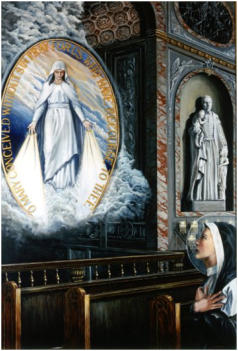
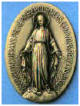
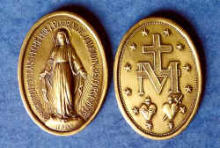
language. The Blessed Virgin "standing in space". She was dressed in white, standing on a globe and holding a golden ball, with rings
on her fingers flashing with light. An inner voice told her that the ball represented the whole world and that the rays coming from
Mary's fingers represented graces for individuals. Then, a second phase: The golden ball then vanished as this apparition changed to
represent Mary with her arms outstretched, inside an oval frame with golden lettering:
“O Mary conceived without Sin, pray for us who have recourse to Thee”
Mary gave her this instruction: "have a medal struck on this model. All those who carry this will receive Grace in abundance, especially if they
wear the medal around their neck and say this prayer confidently, they will receive special protection from the Mother of God and abundant
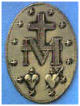
graces". Then it is although the whole scene turns around and Catherine Laboure can see the back of the medal: in the
centre is the letter M, from where a Cross ascends with at its base a cross-beam which passes through the letter M and
below this the two hearts of Jesus and Mary, one crowned with thorns the other pierced by the sword of sorrow. The whole
is surrounded with a crown of 12 stars recalling the vision of St. John in the twelfth chapter of the Apocalypse or Book of
Revelation. Catherine Laboure hears: "the M with the Cross and the two hearts say enough".
“I am the Immaculate Conception”
During the next year this apparition occurred five times and each time with the same instructions: "have a medal struck on this model, and all
those who wear it will receive great graces, especially when worn around the neck". Sister Catherine endured many humiliations, but she
persevered. It took two years before her confessor, Father Aladel, a Vicentian priest, had the medal struck. The original name of the medal is that of
holy Mary’s Immaculate Conception; only after 7 years was the name changed to the “Miraculous Medal”. Because of the many answered prayers,
the conversions and the cures, some 10 million medals were sold during the first 5 years. The short prayer: "O Mary conceived without sin, pray for
us who have recourse to Thee", has since been prayed innumerable times by believers, so that the entire Christianity became familiar with Mary's
"Immaculate Conception". It was Pope Pius IX who made it a rule of faith. This was received with great joy by the entire Church. Four years later,
Mary came as though to confirm this, when She said to Bernadette at Lourdes:
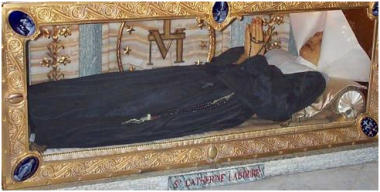
Catherine Laboure died on 31st December 1876. When her body was exhumed, after fifty-seven years of burial, it was found to be completely
incorrupt and supple. Her eyes were as blue as the day she died. On 28th May, 1933 she was beatified by Pope Pius XI. This occasion was
witnessed by 50,000 people, of which there were 8,000 children of Mary, veiled in white, all wearing the Miraculous Medal. On 27th July, 1947
Catherine Laboure was canonized by Pope Pius XII. Here again many believers were present, including more than 10,000 children of Mary, veiled
in white.
Many healings, including those of people for whom there was totally no hope, were attributed to the "Miraculous Medal". Just in the American city
of Philadelphia alone, between 1930 and 1950, more than 750.000 favours were granted and registered. Catherine Laboure is still lying in state at
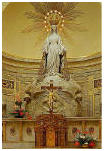
the right of the altar in the chapel Rue du Bac 140, in Paris and she still looks as though she only died yesterday!
Margaret Mary lived four years more. Why? That she might inform the King of France, "Eldest son of His Sacred Heart," that the Sacred Heart
claims "to reign in his palace, to be painted on his standard, to be engraved on his arms"; and that it will make him "triumphant over all the
enemies of Holy Church." Either Louis XIV never received the letter or he refused to reply. But the command still stands. It was on the feast of
Saint Louis of France that Margaret Mary had made her profession.
THE JEW ALPHONSE RATISBONNE AND THE MIRACULOUS MEDAL (1842)
Basilica Sant Andrea delle Fratte, Rome
(taken from Marypages)
Why would Our Lady appear to a man who hated the Faith?
Marie Alphonse Ratisbonne was born at Strasburg France, on 1 May, 1814. He was the son and heir of a wealthy, aristocratic family of Jewish
bankers. When Alphonse Ratisbonne was still a child his older brother, Theodor, converted to the Catholic faith and became a priest. The family
Ratisbonne reacted with hostility and horror. Alphonse resolved never to communicate again with his older brother, and developed a violent
antipathy to the Catholic faith and to all things Catholic. In 1842, 28 years old, he is engaged to his own niece, Flore Ratisbonne, whom he plans to
marry the following August. Right now, he is touring Europe and the East, partly for pleasure and partly for his
health; one last fling before settling down with Flore and assuming a partnership at his uncle's bank. Ratisbonne
decided to go to Naples, to spend the winter in Malta, to strengthen his delicate health.
In Naples he had mistaken the road and instead of coming to the reservation office for Palermo, as he intended,
he arrived at the stage-coach for Rome. Even after he realized what was up; he remained there and booked his
passage on the steamer to Rome. He left Naples on the 5th and arrived in Rome on the 6th, the feast of the Three
Kings. So here he is, making the best of it, avidly touring Roman ruins and museums in the company of a paid
guide. On January 8, Ratisbonne was called by name on the street. It was his old classmate from Strasburg,
Gustavo de Bussières, a Protestant. The two eagerly rekindle their friendship. Later, when Alphonse calls on
Gustave, he encounters the latter's older brother, the Baron Theodore de Bussières, a convert to Catholicism and
a close friend of Alphonse's priest-brother. Alphonse feels instinctive abhorrence toward this zealous Catholic
convert, but he knows the baron is an expert on Constantinople, which Alphonse plans to visit, so he rashly
agrees to call upon him for travel advice. De Bussières saw it as his mission to convert any unbeliever who
crossed his path in life, to Catholicism. He and Ratisbonne became friends, but Ratisbonne's sarcasm and
blasphemy irritated him enormously.
Finally, the baron makes an extraordinary proposition. "Since you abhor superstition and espouse such liberal
views," he asks Alphonse, "would you consider submitting to a simple test?" "What test?" "To wear something I'm going to give you. It's a medal of
the Holy Virgin. It appears quite ridiculous to you, no doubt. But as for me, I attach great importance to it." And he shows Alphonse the
Miraculous Medal attached to a cord. Alphonse is dumbstruck. He can scarcely believe the baron's impertinence. But as a man of the world, he
doesn't want to seem to be making too much of a trifle. So he consents, breezily quoting a line from The Tales of Hoffman: "If it does me
no good, at least it will do me no harm." The baron's little daughter puts the miraculous medal around Alphonse's neck. And Alphonse
burst out laughing: "Here am I, a Roman, apostolic Catholic!" But this was not enough for De Bussières. "And now", he said, "you must
complete the test. Every morning and evening recite the “MEMORA, a short and efficious prayer, which St. Bernard composed to the
Virgin Mary". Ratisbonne said: "Let it be! I promise to recite this prayer. If it will not do me any good, it will not do me any bad!"
In fact, the baron's relentless proselytism is starting to get on Alphonse's nerves. Far from drawing him toward Catholicism, it is
repelling him further. Yet the baron, undaunted, persists. But the baron is not relying on argument alone. He's also praying very hard.
And so are his friends, his fellow members of Rome's tight-knit community of aristocratic French expatriates. Notable among these
friends is the Count Laferronays, ex-diplomat, once a notorious roue' and now a devout, fervent Catholic. Moved by the baron's pleas,
the Comte drops into a church and fervently prays "more than 20 Memorares" for the conversion of the "young Jew." That very same evening, the
Count suffers a fatal heart attack. After receiving his final Sacraments, he dies devoutly, surrounded by his loving family.
At midday, January 20, 1842, when the Baron was arranging the funeral of his friend Count Laferronays in the basilica of St. Andrea delle Fratte in
Rome he asked Ratisbonne to wait for him in the church. When the Baron came back to the church he found Ratisbonne on his knees in prayer.
This sight moved him to tears. In Ratisbonne's own words: "I was scarcely in the church when a total confusion came over me. When I
looked up, it seemed to me that the entire church had been swallowed up in shadow, except one chapel. It was as though all the light
was concentrated in that single place. I looked over towards this chapel whence so much light shone, and above the altar was a living
figure, tall, majestic, beautiful and full of mercy. It was the most holy Virgin Mary, resembling her figure on the Miraculous Medal. At
this sight I fell on my knees right where I stood. Unable to look up because of the blinding light, I fixed my glance on her hands, and in
them I could read the expression of mercy and pardon. In the presence of the Most Blessed Virgin, even though she did not speak a
word to me, I understood the frightful situation I was in, my sins and the beauty of the Catholic Faith.
The baron helps Ratisbonne outside and into his carriage. He takes him to the Hotel Serny, where Alphonse is staying, and loosens his
cravat so he can breathe. But Alphonse is still sobbing, clasping his Miraculous Medal, murmuring thanks to God. At last he turns to
the baron, embraces him, and with a face "presque transfiguree" says: "Take me to a confessor! When can I receive baptism, without
which I can no longer live?" "What has happened?" exclaims the baron. "What have you seen?" "That," says Alphonse, "I can reveal only on my
knees and to a priest." So...the baron takes him to the Gesu, the Jesuit mother-church, to see Father Villefort. There, Alphonse tries to explain
himself, but he is still sobbing so hard that he is unintelligible. At last he calms down, takes the Miraculous
Medal from his neck, holds it up, and cries: "I saw Her! I saw Her!"
Alphonse Ratisbonne confessed and thought that his family would believe he was insane and would have
ridiculed him. So he prefered to flee totally from the world, its chatter and its judgments. He entered the
convent of the Jesuits to make a retreat under the guide of Father Villefort. January 31, 1842, he received from
the hands of His Eminence Cardinal Patrizi, the Vicar of His Holiness, baptism, confirmation and his first Holy
Communion. The following month, the Vatican holds a canonical process to investigate the circumstances
surrounding Alphonse's conversion. After lengthy investigation and many depositions, it concludes that his
sudden conversion was entirely miraculous; an act of God wrought through the powerful intercession of the
Virgin. In May 1842, only a few months after the apparition, a painting of the Madonna of the Miracle was placed for veneration in exactly the
same spot and in the same form as She appeared. The canvas was painted by the artist Natale Carta, who according to tradition, followed the
indications of Ratisbonne himself. In the same year, after a formal inquest about the apparition of January 20, the Vicar General of Pope Gregory
XVI, Cardinal Patrizi, declared on June 3, 1842, that it was a divine miracle operated through the intercession of the Blessed Virgin Mary, and
permitted the publication and spread of texts recording the miracle.
After his conversion he assisted his brother, Theodor, in founding the Sisterhood of Our Lady of Sion in 1843, was ordained priest in 1847, and
entered the Society of Jesus. Desirous, however, to devote himself entirely to the conversion of the Jews, he left the society with the consent of Pope
Pius IX, transplanted the Sisters of Sion to Jerusalem in 1855, and built for them in 1856 the large Convent of Ecce Homo with a school and an
orphanage for girls. In 1860 he erected the Convent of St. John on the mountain at Ain Karim (where he now lies burried), together with a
church and another orphanage for girls. Here Alphonse laboured with a few companions (Pères de Sion) for the conversion of Jews and
Mohammedans until his death. He died there May 6, 1884. Ratisbonne did try to get in contact with Catherine Labouré, but
never succeeded, as the Sister was shielded from the outside world. There were so many miracles operated by Mary in the
Shrine, that on January 17, 1892, Pope Leo XIII coronated the venerated icon with a diadem. On April 25, 1942, Pope Pius XII
elevated the title of the church to the rank of a basilica. On March 12, 1960, Pope John XXIII elevated the basilica of Sant
Andrea delle Fratte to the title of a cardinal's church. The visit of Pope John Paul II to this church took place on February 28,
1982.
"This apparition to Alphonse Ratisbonne in Rome is fully approved by the Holy See: June 3, 1842"